
Low-Noise Data Centers: How Data Centers & Communities Can Co-Exist
Successfully managing data center noise is no longer simply about meeting regulatory requirements. It is about protecting project timelines, preserving operational performance, supporting community acceptance, and designing facilities that are built to grow. This guide explores why low-noise design has become a critical part of modern data center development and the strategies that deliver lasting results.
Table of Contents


The Rising Demand for Data Centers & Why Noise Is Increasing
Data centers have become essential infrastructure for the global economy. Cloud computing, AI, streaming, e-commerce, financial systems, healthcare platforms, enterprise software, and everyday mobile applications all depend on more computing capacity running around the clock.
That demand is driving a major buildout from hyperscale providers, colocation operators, AI infrastructure companies, cloud platforms, and the OEMs that supply the cooling, power, backup generation, and mechanical systems these facilities rely on. As data centers become larger, denser, and more power-intensive, their acoustic impact becomes harder to ignore.
As AI and high-performance computing increase rack densities, cooling demand rises. More cooling often means more fans, more chillers, more condensers, more air movement, and more potential noise sources.
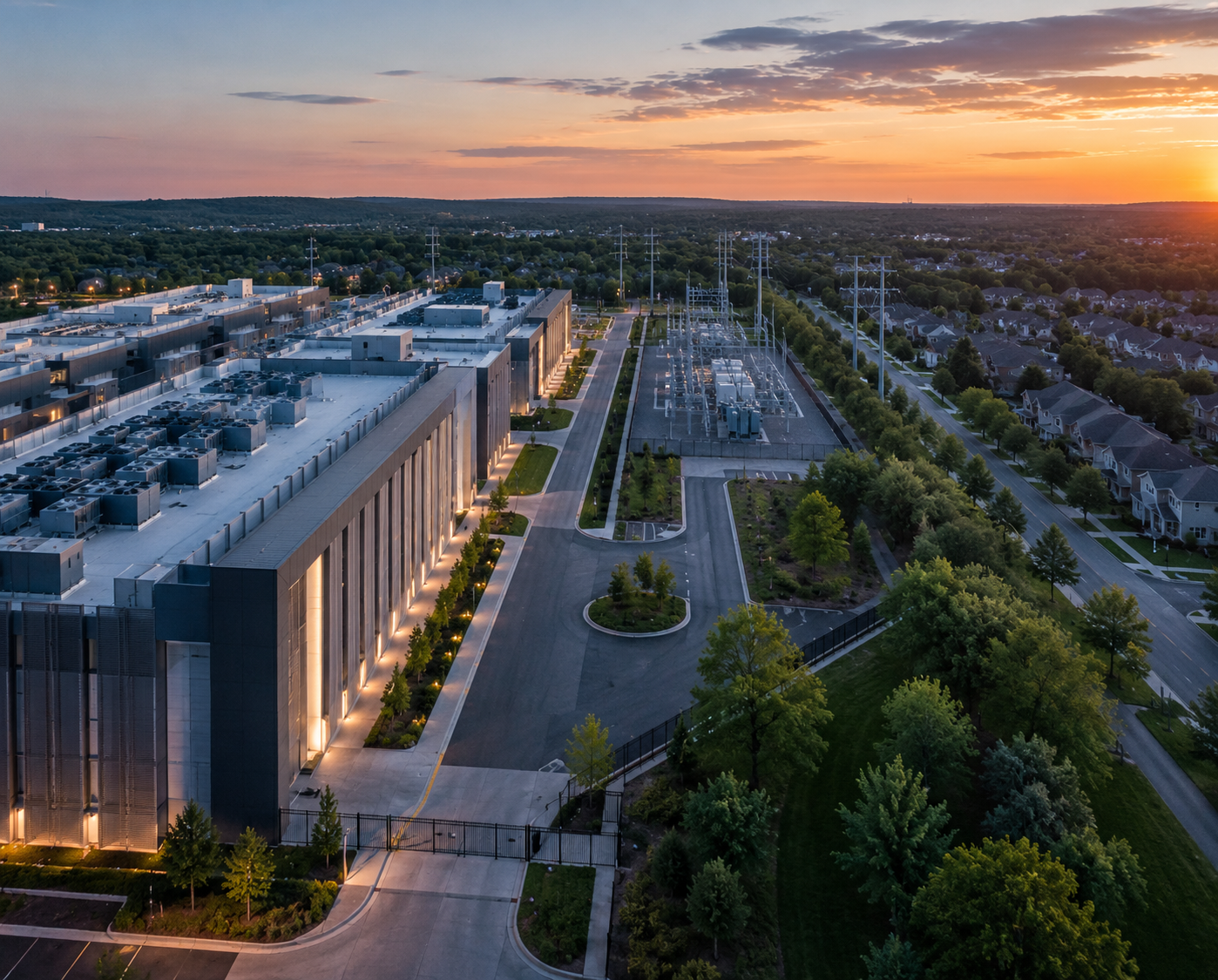
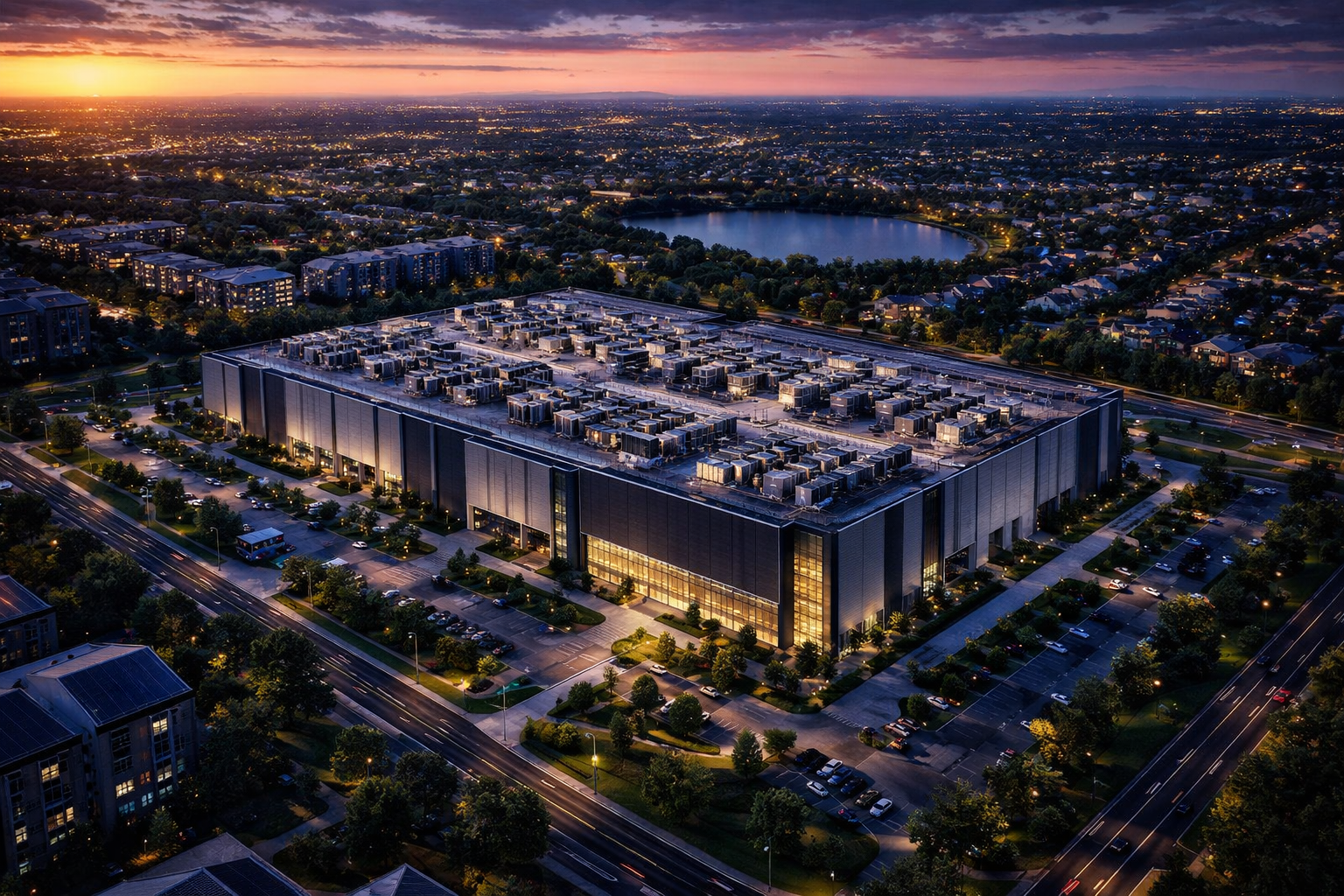
The issue is becoming more visible because data centers are increasingly being developed closer to people. Operators need access to power, fiber, workforce, customers, and existing infrastructure, which often pushes projects near residential, commercial, institutional, and mixed-use areas.
This is especially visible in major U.S. data center markets such as Northern Virginia, including Loudoun County and Prince William County, along with fast-growing regions in Arizona, Texas, Georgia, Ohio, and other states attracting large-scale digital infrastructure.
In these communities, noise is not just an engineering concern. It becomes a public perception issue. Residents may not understand rack density, cooling load, or redundancy requirements, but they do understand a constant hum, tonal sound at night, generator testing, or a facility that feels out of place in the surrounding area.
Building Proximity to Communities
Data centers are expanding closer to core population centers. This can make sense for connectivity, latency, power access, and customer demand, but it also puts mechanical noise closer to sensitive receptors such as homes, schools, healthcare facilities, offices, and mixed-use communities.
This concentration is especially visible in Northern Virginia. The Virginia Economic Development Partnership notes that Loudoun County’s “Data Center Alley” is a global interconnection hub, while the Federal Reserve Bank of Richmond has highlighted Prince William County as a major destination for new data center investment as Loudoun becomes more constrained. Together, these markets show how data center growth is moving from isolated industrial development into regions where power, fiber, land availability, and nearby communities all collide.
Third, higher rack densities are changing the acoustic profile of these facilities. More compute produces more heat. More heat requires more cooling. More cooling creates more acoustic risk.
The result is that data center noise is becoming a planning, permitting, and community relations issue, not just a technical issue.
Why Data Centers Generate So Much Noise
Data center noise comes from the equipment required to keep the facility powered, cooled, and resilient.
Common sources include:
- Cooling Towers
- Air-Cooled Chillers
- Dry Coolers
- Large Fan Arrays
- Mechanical Yard Equipment
- Backup or Prime Power Generators
- Generator Exhaust Systems
- Transformers
Some systems create broadband mechanical noise. Others create tonal or low-frequency sound that can be more noticeable, especially at night. This matters because two sites can have similar sound readings but be experienced very differently by nearby residents.
Redundancy also increases the challenge. N+1, 2N, and other backup configurations are essential for uptime, but they also mean more equipment on site. Even when backup generators are not running continuously, routine testing can become a predictable community friction point.
Noise also changes based on workload, weather, season, equipment staging, and time of day. A site may sound different during peak cooling demand than it does during normal operation. That is why acoustic planning must account for real operating scenarios, not just one average condition.
How Noise Creates Conflict
Noise creates conflict because it sits between regulatory compliance and community experience.
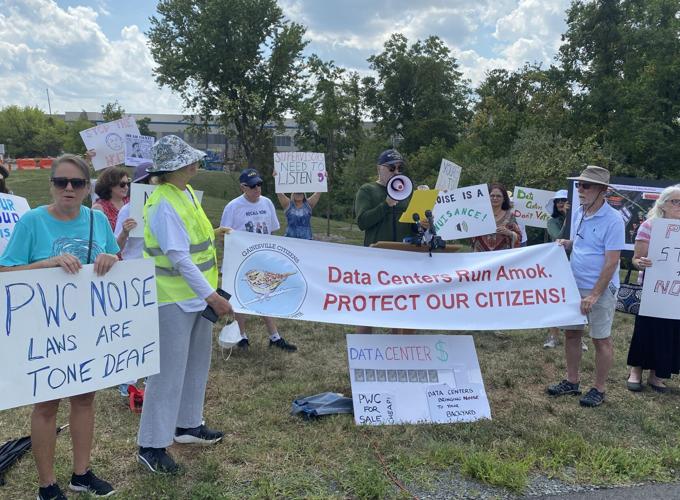
In many cases, especially in the U.S., local noise regulations were not written for large-scale, 24/7 data center campuses. A facility may technically meet a basic property-line limit while still creating community frustration because of tonal noise, low-frequency hum, nighttime disturbance, or the cumulative impact of multiple nearby facilities.
Compliance is not the same as acceptance.
For residents, the problem is often not one loud event. It is the sound that does not go away. A constant nighttime hum can become a daily quality-of-life issue. Once complaints begin, noise can quickly affect approvals, council discussions, expansion plans, public perception, and the operator’s ability to build trust.
This is why noise must be addressed early. Poor acoustic outcomes can lead to complaints, enforcement pressure, redesign requests, operating restrictions, project delays, and lost expansion opportunities. A community that has already dealt with one noisy facility is less likely to support the next one.
Low-noise design is not just about avoiding violations. It is about protecting community coexistence, improving public perception, and keeping future development options open.

The Business Case For Low-Noise Design
Low-noise data center design is often treated as an environmental or community concern. It is also a business issue.
Noise problems can delay approvals, increase project costs, trigger redesigns, damage community trust, and make future phases harder to permit. For operators and developers under pressure to bring capacity online quickly, those risks matter.
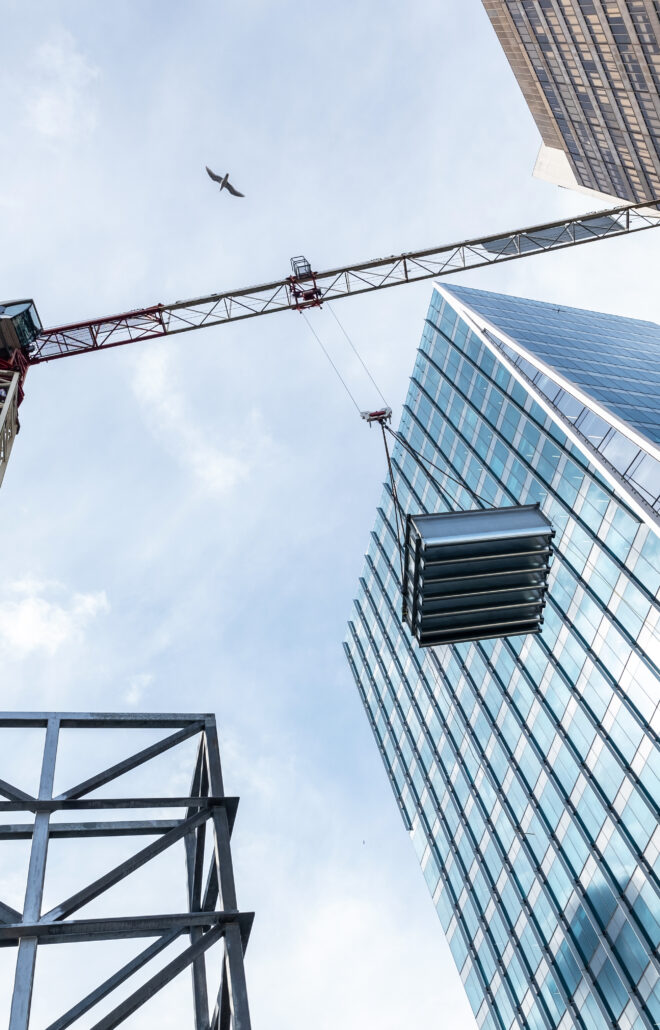
The earlier noise is addressed, the more control the project team has. Site layout, equipment selection, rooftop screening, mechanical yard placement, airflow paths, at-source acoustic silencer silencers, roof-top barriers, and generator enclosure design can all be optimized before the design is locked. Once a facility is built or live, the options become more limited, more expensive, and more disruptive.
Effective noise control must also be site-specific. A data center solution cannot only reduce sound. It also has to protect heat rejection, airflow, access, structural requirements, maintenance, safety, and uptime. A barrier that blocks airflow is not a solution. A silencer that creates too much pressure drop is not a solution. Acoustic design has to work with the mechanical design, not against it.
Risk Avoidance
The first business case for low-noise design is risk avoidance. When acoustic issues are left too late, they can create:
- Permit delays
- Legal disputes
- Community complaints
- Planning board or council pressure
- Redesign requirements
- Late-stage retrofits
- Operational downtime risk
- Reputational damage
The most expensive part is often not the acoustic product itself. It is the delay, uncertainty, redesign, community resistance, and loss of flexibility that come with solving the issue after the fact.
For example, a mechanical yard may be oriented toward nearby homes. Rooftop equipment may need screening after structural assumptions are already set. A generator enclosure may meet a generic specification but fail at the actual point of reception. A chiller layout may work mechanically but create a tonal issue in the surrounding area.
These problems are much easier to prevent than to correct. Early acoustic modeling and coordination helps identify risks before they become expensive constraints.
Faster Approvals & Better Pace To Market
For data center developers, speed to market is critical. Capacity that comes online late can affect revenue, customer commitments, and competitive positioning.
Low-noise design can support faster approvals by giving regulators, planning boards, and community stakeholders confidence that acoustic impact has been studied and controlled. This can include predictive modeling, point-of-reception analysis, equipment-specific sound data, daytime and nighttime assessments, and documentation showing how mitigation will work.
This matters because communities are increasingly skeptical of data center projects, especially in regions where development is already concentrated. A project that proactively shows how it will control sound, manage generator testing, and reduce community impact is in a stronger position than one that only points to minimum code compliance.
Low-noise planning can also improve public perception. It shows that the operator is thinking about coexistence before complaints begin. That can reduce friction, support smoother approvals, and protect future expansion opportunities.
The Cost of Delay Is Bigger Than the Retrofit
Low-noise design can reduce lifetime costs by addressing acoustic performance early—and helping protect the schedule throughout the project.
Delays can emerge at virtually any stage of a data center project. Engineering, permitting, procurement, and installation all introduce potential points of disruption. When acoustic requirements are not addressed early, they can create additional coordination, redesign, procurement, or installation challenges that compound as the project progresses.
Once a facility is built, acoustic mitigation becomes even more complex. Solutions may need to fit around existing equipment, protect live operations, preserve access, and avoid disrupting cooling. What could have been incorporated into the original design can become a costly retrofit requiring additional structural work, coordination, and installation time.
As a planning principle, late-stage acoustic retrofits can cost 3 to 5 times more than addressing the issue during design. In complex data center environments, retrofit costs can reach $100K to $500K per mechanical unit, depending on scope, access, structural requirements, airflow constraints, and operating conditions.
But the cost of the acoustic work is only part of the equation.
Every week of project delay carries its own cost.
Industry estimates illustrate the potential scale:
1 WEEK → $100M
2 WEEKS → $300M
3 WEEKS → $500M
When the financial impact of delay can escalate this quickly, an acoustic issue is not simply a line item to solve later. It can introduce risk at multiple points across the project lifecycle—from engineering and permitting through procurement and installation.
That’s why low-noise design should be approached as risk mitigation from the start. By integrating acoustic, mechanical, and structural requirements early, teams can identify constraints before they become redesigns, procurement issues, installation challenges, or operational disruptions.
Because when every week matters, solving noise early can help protect the schedule, the budget, and the path to operation.
Where Can Delays Pop Up?
Engineering
Resolve acoustic requirements before they become redesigns.
Permitting
Address noise criteria before they become approval constraints.
Procurement
Coordinate specifications and equipment requirements before they affect lead times.
Installation
Avoid complex field modifications that can add time, coordination, and operational risk.

Understanding Data Center Noise in
Technical Terms
Noise may feel subjective, but data center noise has technical patterns that can be measured, modeled, and controlled.
The challenge is that the most disruptive sound is not always the loudest sound. A low-frequency hum, tonal fan sound, or nighttime mechanical signature can trigger more complaints than a higher sound level that blends into the background.
That is why data center noise has to be evaluated in both technical terms and human terms.
What Noise Really Is: A Practical Primer
The most common environmental noise metric is the decibel, often measured as dBA. A-weighting approximates how the human ear perceives many common sounds, which is why it is widely used in regulations.
Tonal noise, such as a fan whine or transformer hum, can stand out even when the overall sound level is not extreme. Broadband airborne noise may be less irritating because it blends more easily into the background.
A proper data center noise assessment may consider frequency content, daytime versus nighttime limits, background sound levels, reflections from nearby surfaces, rooftop source height, distance to sensitive receptors, and cumulative sound from multiple systems.
The goal is not only to reduce a number on a report. The goal is to understand how the facility will actually be heard by the surrounding community.

How Noise is Regulated Globally
Data center noise is regulated differently by region.
In the U.S., requirements are often controlled through municipal bylaws, zoning conditions, property-line limits, or project-specific approvals. In Canada, provincial and municipal requirements may apply. In Europe and other international markets, environmental noise standards, planning frameworks, and point-of-reception limits may guide assessment.
The challenge is that regulations do not always capture real community expectations. Many rules focus on basic sound levels, but may not fully account for tonality, low-frequency hum, cumulative impact, or continuous nighttime operation.
In markets such as Chandler, Arizona, external reporting has shown how a constant mechanical hum from data center operations can escalate into resident complaints and broader community concern, reinforcing why low-frequency and continuous 24/7 noise need to be addressed beyond basic compliance.
For operators, the lesson is simple: treat compliance as the floor, not the full strategy.
Why Data Center Noise is Complex
Data center noise is regulated differently by region.
In the U.S., requirements are often controlled through municipal bylaws, zoning conditions, property-line limits, or project-specific approvals. In Canada, provincial and municipal requirements may apply. In Europe and other international markets, environmental noise standards, planning frameworks, and point-of-reception limits may guide assessment.
The challenge is that regulations do not always capture real community expectations. Many rules focus on basic sound levels, but may not fully account for tonality, low-frequency hum, cumulative impact, or continuous nighttime operation.
In markets such as Chandler, Arizona, external reporting has shown how a constant mechanical hum from data center operations can escalate into resident complaints and broader community concern, reinforcing why low-frequency and continuous 24/7 noise need to be addressed beyond basic compliance.
For operators, the lesson is simple: treat compliance as the floor, not the full strategy.
Designing Low-Noise Data Centers
From Day One
The best time to solve a data center noise problem is before the facility is built.
Early acoustic planning gives project teams more options. Site layout, equipment placement, rooftop screening, mechanical yard design, generator attenuation, airflow paths, and future expansion plans can all be evaluated before the design is locked.
Once construction is complete, solutions become more constrained, more expensive, and harder to install without affecting operations.
Low-noise design should not be treated as a final compliance item. It should be part of the planning process from the beginning.
The Value of Early Acoustic Coordination
Acoustic design works best when it is coordinated with mechanical, structural, and operational requirements.
A solution that reduces sound but blocks airflow is not a good solution. Neither is a solution that limits maintenance access, creates complications for structural integration, or interferes with heat rejection.
The goal is to reduce acoustic risk while protecting uptime, cooling performance, and long-term serviceability.
Engineered Acoustic Solutions
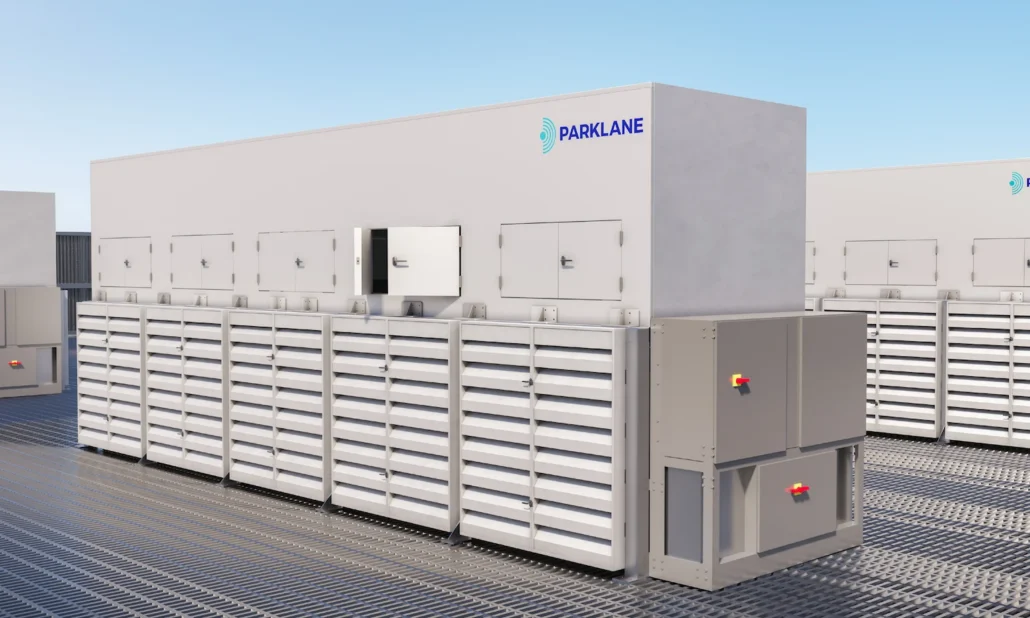
Low-noise data center design often requires engineered, integrated acoustic solutions, not one-size fits all barriers or off-the-shelf products.
Depending on the site, this may include:
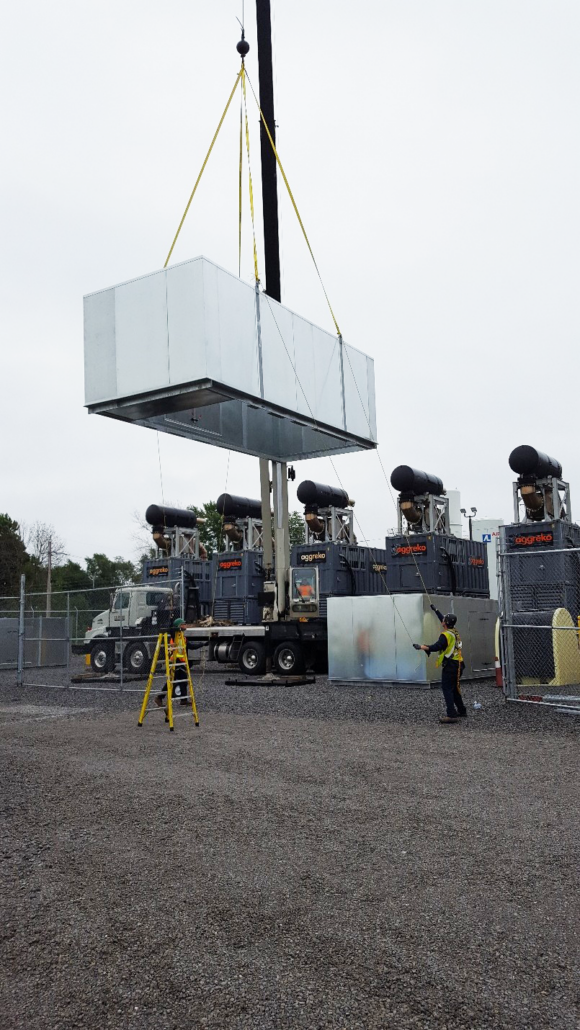
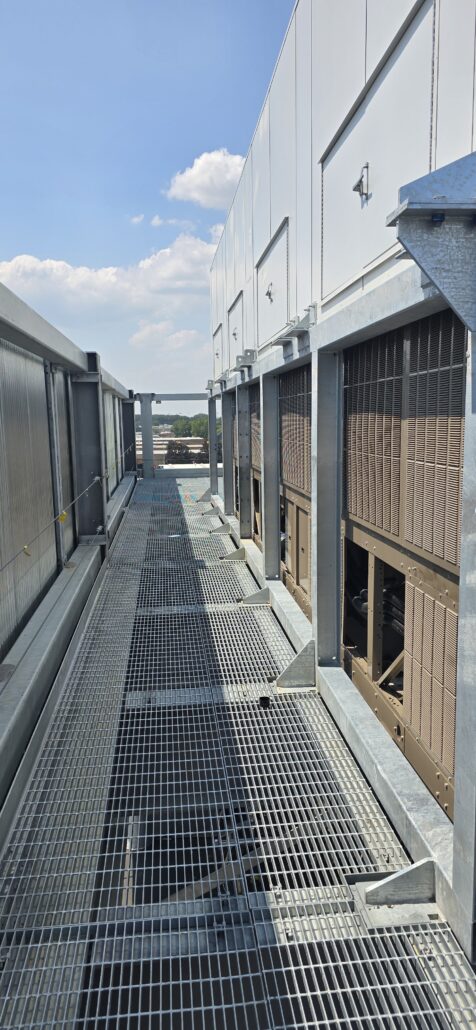
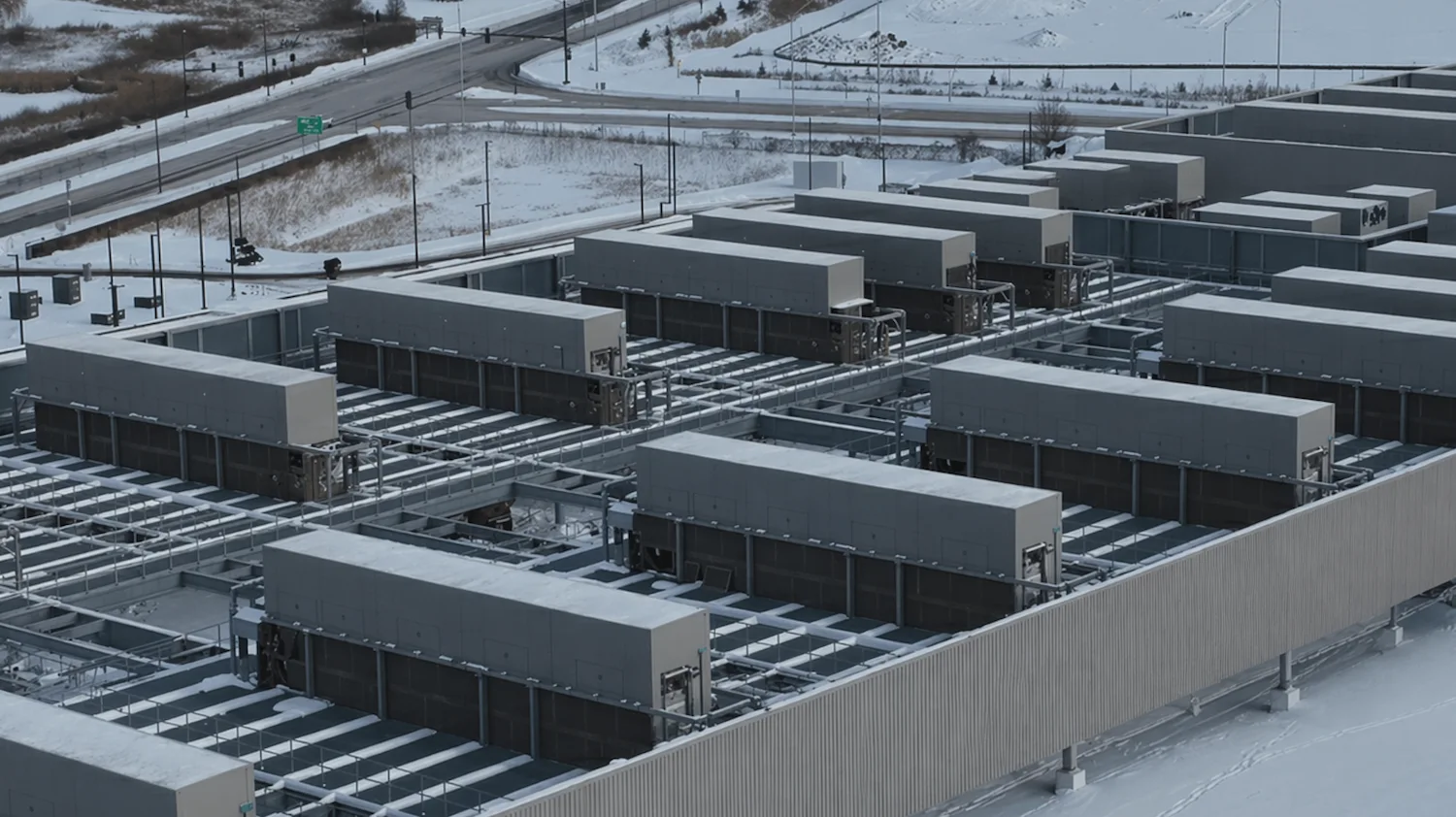
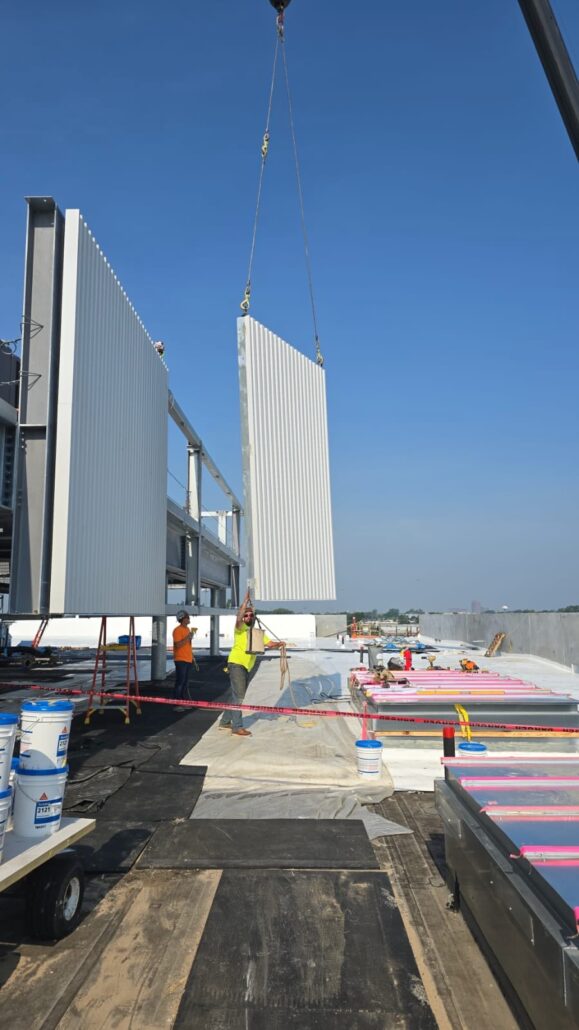
- Modular Acoustic Roof Barriers
- Custom Silencers for general building ventilation
- Custom Air Handler attenuation packages
- RTU attenuation packages
These systems must be designed around the actual equipment, sound source, airflow path, structure, and operating condition. The right solution reduces noise without compromising performance.
Site Planning & Equipment Placement
Many noise issues begin with layout.
Mechanical yards, rooftop systems, generators, transformers, and airflow discharge points should be evaluated in relation to nearby homes, schools, healthcare facilities, offices, and other sensitive receptors.
Smart site planning can reduce the amount of mitigation needed later. This may include orienting equipment away from receptors, using buildings as natural shields, separating high-noise equipment from property lines, and planning for future phases before the site becomes crowded.
Mechanical System Design
Mechanical systems are often the dominant source of continuous data center noise.
Cooling towers, chillers, condensers, fan arrays, rooftop units, and ventilation systems all need to be assessed for sound level, frequency profile, tonality, and operating schedule.
Design teams should consider low-noise equipment options, variable-speed operation, airflow direction, discharge paths, silencer requirements, and the way multiple systems combine across the site.
The most effective approach is not simply choosing quieter equipment. It is designing the system so cooling, airflow, and acoustic performance work together.
Retrofit Solutions For Existing Data Centers
Once a facility is live, every mitigation decision has constraints.
There may be limited space around equipment. Rooftop structures may not have been designed for added loads. Mechanical yards may already be crowded. Cooling systems may be operating near capacity. Maintenance teams still need access.
This is why retrofit work requires site-specific acoustic and engineering review. The solution has to fit the facility that actually exists.
Proven Retrofit Strategies
Common retrofit strategies include:
The right strategy depends on the source of the noise, the available space, the surrounding receptors, and the operational limits of the facility.
Avoiding New Problems During Retrofit Work
Poorly planned retrofits can create new risks.
A barrier can reduce sound but trap heat. A silencer can lower noise but restrict airflow. An enclosure can improve acoustic performance but make maintenance harder.
Successful retrofits balance acoustic performance with the realities of data center operation. The objective is not just quieter equipment. It is quieter equipment that still works exactly as the facility needs it to.

How Data Centers &
Communities Can Co-Exist
As data centers move closer to residential and mixed-use areas, community acceptance becomes harder to separate from project success.
Most residents do not object to digital infrastructure in theory. They object when a facility changes the way their neighborhood feels, sounds, or functions.
Noise is one of the most immediate concerns because people experience it directly. A constant hum, tonal sound, or recurring generator test can quickly become a quality-of-life issue.
Understanding Community Impact

Community concern is no longer hypothetical.
In Fort Worth, Texas, residents recently urged city leaders to pause additional data center development, citing concerns about noise, environmental impact, and overall community quality of life. The debate reflects a broader trend as data centers move closer to residential areas and communities become more focused on how large-scale digital infrastructure will affect daily living.
Similar discussions are appearing in other markets across North America as hyperscale and AI infrastructure expand into new regions. In many cases, the conversation extends beyond compliance and focuses on how facilities will coexist with nearby neighborhoods over the long term.
These concerns can influence public meetings, planning discussions, permitting decisions, community sentiment, and future expansion opportunities.
Noise should therefore be treated as both an engineering issue and a community relations issue.
Compliance Is Not
The Same As Acceptance
A project can meet a basic regulatory limit and still frustrate nearby residents.
This is especially true when the sound is tonal, low-frequency, continuous, or most noticeable at night. Residents may not care whether a facility technically meets a property-line standard if the sound is still disruptive inside their homes or yards.
The better strategy is to treat compliance as the floor, not the goal.
Community Engagement
Best Practices
Strong community engagement starts with transparency.
Operators should clearly explain expected noise levels, mitigation steps, generator testing schedules, monitoring plans, and response protocols for complaints.
It is also valuable to compare the project’s expected performance against regulatory limits and show where the design goes beyond minimum requirements when necessary.
That gives residents and regulators a clearer picture of what is being done, why it matters, and how the facility will be managed after opening.
Acoustic & Airflow Modelling, Predictive Analysis, & Regulatory Compliance
Predictive acoustic and CFD modelling helps project teams understand noise and airflow risk before noise control solutions are installed.
Using site layout, equipment data, operating conditions, terrain, receptor locations, and mitigation assumptions, engineers can model how sound and air are likely to move through the solution and beyond the site.
This helps teams identify problems early, test solutions, and document expected performance before the project reaches a more expensive stage.
Learn more about:
What Modelling Can Show
- Property-line sound levels
- Point-of-reception impacts
- Daytime and nighttime performance
- Tonal or low-frequency concerns
- Generator testing scenarios
- Rooftop and mechanical yard sources
- Cumulative impact from multiple systems
- Expected performance after mitigation
The value is not just the model itself. The value is using the model to make better decisions.
Supporting Compliance and
Community Confidence
Modelling can also support approvals and public confidence.
When regulators or residents ask how a project will manage noise, predictive analysis gives the project team a clearer answer. It shows what was studied, what risks were found, and what mitigation steps were built into the design.
That can help reduce uncertainty and make the approval process less reactive.
The Complete Low-Noise Toolkit for
Data Centers
There is no single product that solves every data center noise issue.
Effective mitigation usually combines multiple solutions across the site. The toolkit may include structural, mechanical, and equipment-specific strategies.
Common solutions include:
- Generator Enclosures
- Acoustic Enclosure Systems
- Chiller Attenuation Packages
- Acoustic Louvers
- Air Handler Attenuation Packages
The right combination depends on the equipment, site layout, receptors, airflow requirements, structure, and operating schedule.
Why Site-Specific Solutions Matter
Two data centers can use similar equipment and still require different acoustic strategies.
One site may need rooftop screening. Another may need chiller discharge attenuation. Another may need generator enclosure upgrades, intake louvers, or ventilation silencers.
The best results come from diagnosing the actual noise path and designing around the full operating environment.
Innovation in Data Center Noise Control
As data centers become larger, denser, and more power-intensive, acoustic solutions also need to become more integrated.
The most effective partners do not simply provide a product. They help evaluate the site, identify risk, coordinate with engineering teams, protect airflow, and design solutions that work in real operating conditions.
For data centers, that kind of integration is increasingly important.
Future Trends in Data Center Noise &
Community Relations
Data center noise will likely become a larger issue as AI workloads, higher rack densities, and power-intensive facilities continue to grow.
More compute means more heat. More heat means more cooling. More cooling can mean more acoustic risk.
At the same time, communities are becoming more aware of data center impacts. Public concern is expanding beyond power and water to include noise, land use, visual impact, and quality of life.
Low-Noise Design as a Competitive Advantage
Low-noise design can help operators reduce risk, protect approvals, improve community trust, and keep future expansion options open.
In crowded markets, that matters.
A facility that can demonstrate responsible acoustic planning may be better positioned than one that waits for complaints before acting.
Next Steps
Data center noise is no longer a secondary design issue.
As facilities become larger, denser, and closer to communities, acoustic performance has a direct impact on approvals, operations, reputation, and long-term growth.
The strongest approach is proactive. Study the site early. Understand the sources. Model the risk. Design mitigation around real operating conditions. Then communicate clearly with regulators and the community.
Low-noise design is not just about reducing sound. It is about reducing project risk.
To move forward, connect with a Parklane noise control expert who can review your project needs, identify the highest-risk sources, and develop a practical mitigation plan before noise becomes a larger problem.