
Industrial Manufacturing Facility
Ardent Mills
Parklane was engaged alongside Valcoustics to develop a multi-phase noise mitigation strategy targeting this grain processing facility’s dominant sound sources. Rather than relying on a single form of attenuation, the project required a combination of acoustic enclosures, circular and rectangular discharge silencers, plenum silencers, and acoustic barriers. Each solution was engineered around existing equipment and operating conditions while maintaining the airflow, access, and serviceability required for continued facility operation.
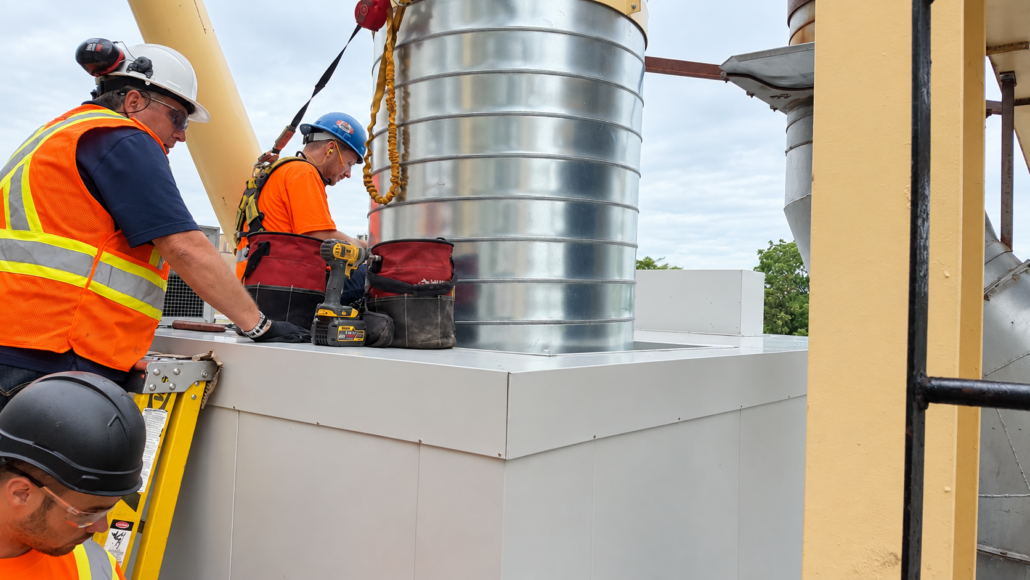
Overview
Parklane was engaged to provide a comprehensive acoustic mitigation package addressing multiple noise sources throughout the Ardent Mills facility.
The first phase focused on Hilltop Silo aeration and receiving fans, the Hilltop Area Vacuum Blower, ‘A’ Silo receiving fans, low-level silo aeration fans, and the Drag Line Drive. Acoustic performance requirements varied by source, with required minimum reductions ranging from 12 dBA to 20 dBA.
A second phase expanded the mitigation strategy to additional collector blower and silo receiving fan equipment, incorporating further discharge silencing and acoustic enclosure systems.
The Project Facility
Ardent Mills Grain Processing Facility
The Noise Sources
Aeration Fans
Silo Receiving Fans
Vacuum Blower
Drag Line Drive
Collector Blower
The Solutions
Acoustic Enclosures
Plenum Silencers
Circular Discharge Silencers
Rectangular Silencers
Acoustic Barrier
The Project Team
Valcoustics – Acoustical Consultant
Reason for Mitigation:
Reduce noise emissions from multiple dominant mechanical sources, with source-specific acoustic targets and particular attention to low-frequency tonal noise associated with the Hilltop Silo Receiving Fan.
Project Challenges

Multiple Noise Sources Across an Operating Facility
The project involved numerous mechanical noise sources distributed throughout the facility, each presenting different acoustic and physical conditions. Rather than applying the same solution across every source, each mitigation measure needed to respond to the equipment configuration, required noise reduction, airflow requirements, maintenance needs, and surrounding site conditions. This resulted in a coordinated package of silencers, enclosures, and barriers engineered specifically for the equipment they served.
Low-Frequency Tonal Noise
The Hilltop Silo Receiving Fan presented one of the most demanding acoustic requirements of the project. A minimum 20 dBA reduction was required, with particular focus on an 80 Hz tone subject to a 5 dB tonal penalty from the Ministry of the Environment.
The challenge was compounded by two additional fans and a high-pressure vacuum pump operating nearby. These surrounding sources had the potential to acoustically mask the subject fan; however, investigation determined that the Hilltop fan was the primary concern and mitigation was therefore concentrated on that source.
Retrofitting Existing Mechanical Equipment
Much of the project involved introducing new acoustic systems around existing equipment rather than designing mitigation into a new installation.
Silencers and enclosures were therefore needed to accommodate existing fan orientations, stack diameters, structural conditions, airflow paths, electrical components, and maintenance requirements.
The resulting systems were designed to provide the required attenuation while remaining practical for long-term facility operation and equipment servicing.


Maintaining Equipment Access
Effective noise control could not come at the expense of equipment accessibility.
The Hilltop Silo Upper Aeration Fan plenum, for example, required a “clam shell” configuration that would allow major fan maintenance despite the discharge attenuation system positioned above the equipment.
Parklane addressed this through vertically removable, cassette-style silencer pods and opposing hinged access doors, allowing the acoustic system to remain integrated around the fan while preserving access when required.
Project Solution
Design
Phase 1
Hilltop Silo Upper Aeration Fans:
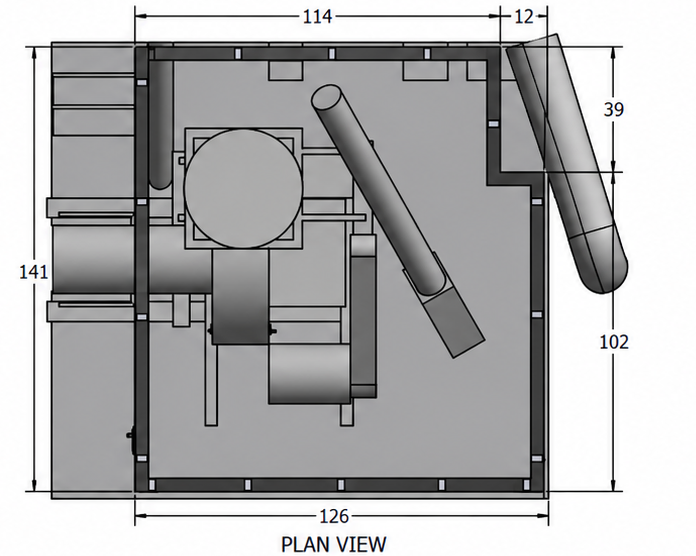
Parklane developed a custom plenum silencer system designed to fully encompass the perimeter of the aeration exhaust fan. The roof of the plenum incorporated an open arrangement with discharge core pods engineered to attenuate discharge air noise from the fan.
To accommodate major maintenance, the discharge silencer pods were designed to be vertically removable in a cassette-style configuration. The enclosure incorporated 20-gauge pre-finished steel exterior skins and single-leaf hinged access doors on opposing sides of the fan for quick equipment access.
Hilltop Area Vacuum Blower:
The existing vacuum blower was retrofitted with an acoustic enclosure incorporating intake and discharge silencers together with a ceiling-mounted LFI X24 exhaust fan.
This approach provided source-level attenuation around the blower while maintaining the ventilation required for equipment operation.
Hilltop Silo Receiving Fans:
Nineteen Hilltop Silo Receiving Fans were addressed using circular discharge silencers. Each silencer was vertically aligned with the original stack orientation and secured using angle-iron collars designed to match the existing stack diameter.
Steel cables provided lateral support in all directions. An acoustic fan enclosure incorporating intake and discharge silencers and a ceiling-mounted LFI X24 exhaust fan was also used to provide additional attenuation while supporting required ventilation.
‘A’ Silo Receiving Fans:
Five ‘A’ Silo Receiving Fans were retrofitted with new discharge silencer assemblies and acoustic enclosures to achieve a minimum 15 dBA noise reduction.
Circular discharge silencers were installed vertically in the original stack orientation using custom angle-iron collars matched to the existing stack diameters and supported laterally with steel cables. The accompanying acoustic fan enclosures incorporated intake and discharge silencers and ceiling-mounted LFI X24 exhaust fans.
Low-Level Silo Aeration Fans:
The Low-Level Silo Aeration Fans required a series of horizontally aligned circular discharge silencers. The silencers were fastened using angle-iron collars designed around the existing aeration fan connections and configured according to each discharge arrangement.
In total, the solution incorporated 21 silencers (four straight configurations and 17 elbow configurations), designed to achieve a minimum 15 dBA reduction.
Drag Line Drive:
Noise from the Drag Line Drive was addressed using an L-shaped, non-penetrating Gravity acoustic barrier.
The barrier was positioned around the equipment to reduce sound propagation from the drive while avoiding the need for penetrating connections.
The solution was designed around a required noise reduction of 12–14 dBA.



Phase 2
Following the first phase of mitigation, Parklane provided additional acoustic solutions for the Hilltop Collector and Silo Receiving Fan equipment.
Hilltop Collector Silencing:
A circular discharge silencer was introduced to attenuate noise associated with the collector blower discharge.
The source-focused approach allowed attenuation to be applied directly to the discharge path while integrating with the existing mechanical configuration.
Silo Receiving Fan:
Additional mitigation for the Silo Receiving Fan incorporated a rectangular discharge silencer and acoustic enclosure.
The enclosure included intake and discharge silencers together with an LFI wall-mounted propeller fan ventilation system.
Maintenance and operational access were integrated directly into the enclosure design, including dedicated access to the main equipment, electrical panel, and motor wiring plug panel.
Results
The Ardent Mills project demonstrates how complex industrial noise challenges can require multiple forms of acoustic mitigation working together as a coordinated system.
Across two phases, Parklane engineered source-specific solutions for fans, blowers, aeration equipment, and material-handling systems, with acoustic targets ranging from 12 dBA to 20 dBA of reduction.
By combining acoustic enclosures, plenum silencers, circular and rectangular discharge silencers, and acoustic barriers, the mitigation strategy addressed the distinct acoustic characteristics and physical constraints of each source rather than relying on a one-size-fits-all approach.
Just as importantly, the systems were designed around the realities of an existing operating facility. Removable silencer components, integrated ventilation, custom connections, and dedicated access points helped ensure acoustic performance could be achieved while preserving equipment operation and long-term serviceability. The result was a multi-phase, site-integrated noise control strategy engineered around both acoustic performance and the practical requirements of the facility.

Read the full story
View the full write up to learn more about how we helped this grain processing facility get noise compliant.
