

As thermal capacity scales, so does acoustic impact. New OEM chiller platforms, such as the YORK® YVAM Air-Cooled Magnetic Bearing Centrifugal Chiller and the Trane Ascend™ Air-Cooled Chiller Model ACR, are fundamentally reshaping high-density data center design. Air-cooled systems now deliver up to 3–3.5 MW per unit, enabling higher capacity density and, in many cases, a reduced total number of chillers required onsite.
While fewer units can simplify layouts and reduce the number of distributed sound sources, higher output per unit can concentrate acoustic energy. This creates a more challenging noise profile. For example, replacing fourteen 2 MW units (each at 100 dBA sound power) with eight 3.5 MW units (each at 107 dBA) increases the overall sound power level from approximately 111.5 dBA to 116 dBA. Overall noise levels are far more sensitive to individual unit sound power than to the sheer number of sources.
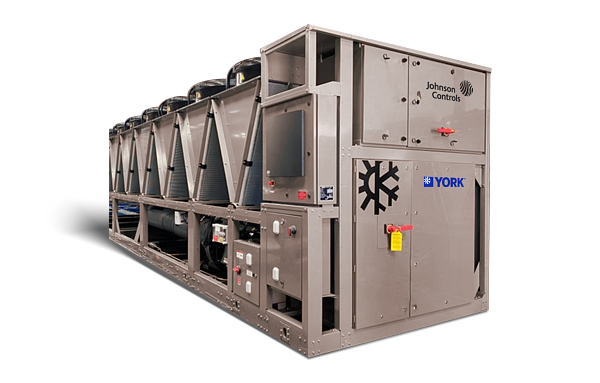
These next-generation systems are engineered for AI-driven rack densities, and extreme ambient conditions. Larger condenser sections and higher airflow volumes can significantly elevate broadband fan noise if designs do not prioritize acoustics the way Johnson Controls has with the YDAM. Increased equipment size and airflow may also increase low-frequency sound content, which can be more noticeable at neighbouring receptors due to its propagation characteristics and ability to penetrate building envelopes.
Image on Left: YORK® YDAM Air-Cooled Magnetic Bearing Centrifugal Chiller
Advancements such as magnetic bearing compressors offer clear acoustic advantages over traditional screw compressors, including lower vibration and reduced tonal content. Integrated free cooling further creates opportunities to optimize staging and reduce noise. However, these technologies only deliver their full acoustic benefit when deliberately integrated into the overall noise control strategy from the outset.
As output per unit continues to rise, environmental noise control must move upstream in the design process.
At Parklane, we support next-generation cooling design as both a performance challenge and a critical community interface. Working closely with the acoustical consultant and OEM, our team helps evaluate full-load and part-load scenarios early in the design phase to accurately predict broadband and low-frequency impacts at sensitive receptors. We then collaborate on practical, integrated noise control solutions—including equipment-level treatments, barrier systems, and architectural integration—that preserve thermal performance while achieving regulatory compliance and community acceptance.
To learn more about Parklane’s process: https://parklanemechanical.com/our-process
To explore our Data Centers: https://parklanemechanical.com/data-centers
To contact us for more information: https://parklanemechanical.com/contact