
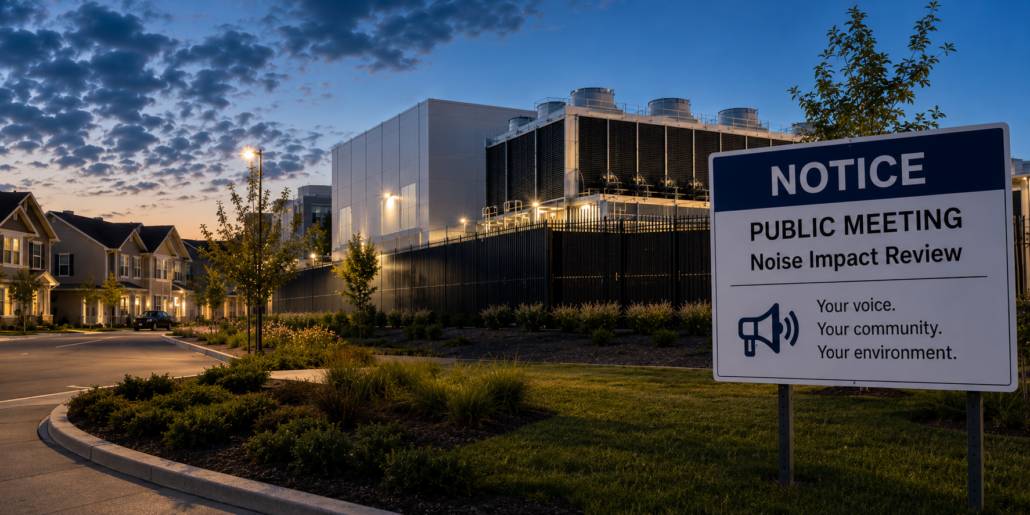
Noise is no longer a secondary permitting issue. It has become a headline concern across North America. In 2026, municipalities continue to tighten decibel limits, refine ordinance language, and ramp up enforcement. At the same time, public awareness has surged. Community meetings increasingly focus on acoustic impacts, and local media are giving prominent coverage to high-profile noise disputes.
A notable trend is the growing sensitivity to low-frequency sound. “Low hum” complaints, particularly near data centers, manufacturing plants, and energy facilities, are prompting regulators to scrutinize how sound is measured and modeled at property lines. Compliance is no longer based solely on overall decibel levels, but also on tonal characteristics and how the noise is actually perceived by nearby receptors.
Backup generators are receiving greater scrutiny during environmental noise assessments, with many jurisdictions requiring stationary noise sources to be evaluated as part of overall facility compliance. Sources: NYC Noise Code | EPA
In response, forward-thinking operators are integrating acoustic considerations much earlier in project delivery. Rather than treating noise as a downstream constraint, they are addressing it alongside core engineering decisions during the design phase. Predictive modeling and field studies, long-established tools, are now being used more strategically to evaluate performance upfront, reduce risk, and move well beyond minimum compliance.
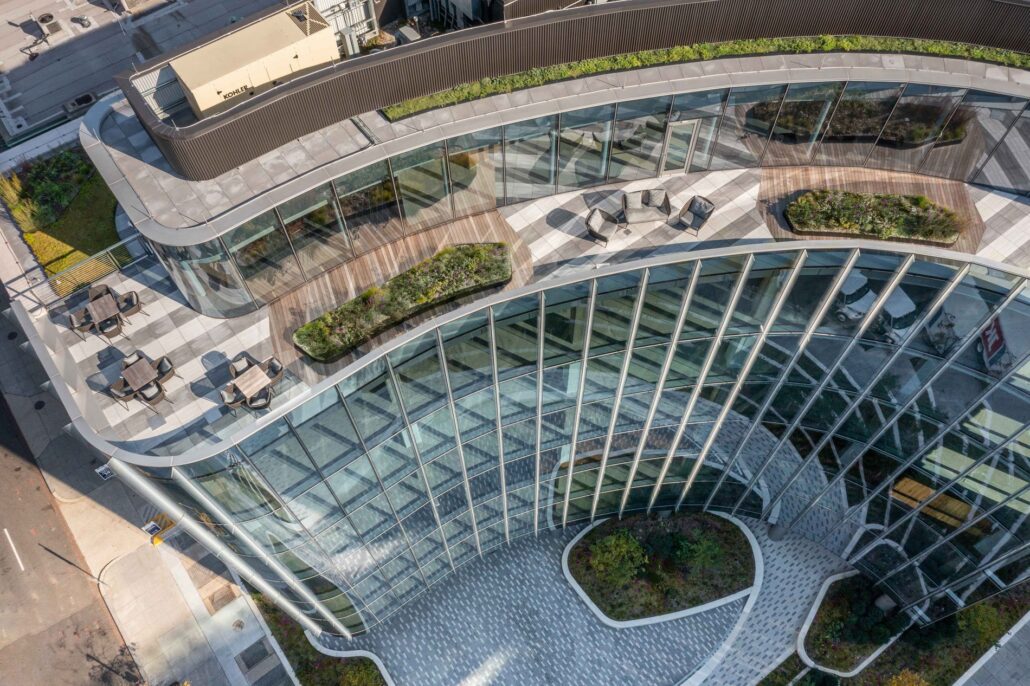
This evolution reflects a broader industry shift toward holistic, human-centered design. Building performance frameworks such as LEED v5, WELL v2, and Green Globes are increasingly recognizing acoustics as an essential part of indoor environmental quality, with attention to acoustical comfort, privacy, communication, and occupant experience. Parklane has contributed to this broader movement through the work of by Viken Koukounian, whose involvement in standards and frameworks developed by organizations including the U.S. Green Building Council, the International WELL Building Institute, the Green Building Initiative, ASA/ANSI, ASTM, ASHRAE, CSA, and ISO has helped advance the integration of acoustics into human-centered building design.
The resulting framework recognizes that successful acoustic design extends beyond decibel limits and compliance targets. It focuses on how occupants perceive and interact with their environment, balancing comfort, privacy, and communication through clearly defined acoustic objectives and measurable criteria. This reflects the same philosophy Parklane applies to environmental noise control projects: addressing acoustics proactively during design to achieve outcomes that support both operational performance and community well-being.
As sound standards continue to evolve across North America, environmental noise control must be proactive, not reactive. At Parklane, we see acoustic performance as both a regulatory requirement and a long-term community responsibility, one best addressed early in the design process, where expectations can be clearly defined and delivered as measurable outcomes before issues arise.
To learn more about Parklane’s process: https://parklanemechanical.com/our-process
To explore the industries we serve: https://parklanemechanical.com/industries-served
To contact us for more information: https://parklanemechanical.com/contact