

Over the past 20 years, the data center industry has seen one of the most dramatic transformations of any sector. What began as slow, bespoke, enterprise-owned “data cathedrals” has evolved into a global ecosystem of hyperscale campuses, modular deployments, and AI-driven facilities, moving faster, growing denser, and landing closer to communities than ever before.
With this shift comes a new set of constraints and risks. Noise, once considered a non-issue, has quickly escalated to a board-level concern and, in many markets, a defining factor in whether modern data centers get approved.
To understand how we got here and where the industry is headed, we spoke with Scott MacIntire, Parklane’s Director of Business Development (West), whose two decades in mission-critical infrastructure and AI give him a unique perspective on the past, present, and future of the data center.
“Urban data centers are going to need to be quiet by design. There’s no way around it.”
– Scott MacIntire, Director of Business Development (West)
The Enterprise Era (Then): Custom, Redundant, And Far From The Public Eye

Two decades ago, the data center landscape was dominated by enterprise-owned facilities. Large organizations built and operated customized sites designed exclusively for their internal IT stacks.
As Scott explains, “These facilities were built like customized homes—slow, bespoke, and incredibly expensive. Cost was secondary to reliability.”
The Enterprise Design Philosophy
- Ultra-redundant mechanical systems
- Concepts like N, N+1, 2N, and 2N+1 governed the design. For instance, if the facility needed 10 chillers (N), owners would install 11 (N+1), 20 (2N), or even more to ensure continuous uptime.
- Fault tolerance was engineered into the building itself, not the applications.
- Mechanical equipment lived indoors, with noise trapped inside these large buildings.
The Enterprise Location Strategy
Noise wasn’t on the radar because:
- Data centers were built on suburban or isolated industrial land.
- Communities rarely interacted with or even knew about them.
The result? Highly reliable, but expensive, slow-to-build facilities with redundancy built into every bolt and beam.

The Hyperscale & Colo Era (Now): Standardized, Fast, AI-Driven, And Close To Communities
By the late 2010s and accelerating sharply after 2022, the explosive growth of hyperscalers and large colocation providers reshaped the data center landscape. This shift reshaped everything. From redundancy strategy to rate of deployment to community risk.
From Bespoke to Standardized
Hyperscalers didn’t and don’t want custom builds. They want speed, scale, and easily repeatable designs. Facilities today are:
- Modular
- Standardized
- Designed for speed-to-market. What was once 3–5 years is now 6–18 months.
- Designed for rapid rack roll-in / roll-out and high-density loads
How Redundancy Changed
Hyperscale growth fundamentally changed the role of Tier III and Tier IV design.
“Tier classifications remain relevant in certain enterprise roles, but they no longer define resiliency strategies for hyperscale environments. ,” Scott says.
Instead of designing fault tolerance into the building:
- Applications themselves are fault-tolerant.
- Workloads automatically shift across zones or regions when failures occur.
- Redundancy lives in software and distributed architecture, not hardware.
In other words: Hyperscale scale replaced facility-level redundancy.
“We’re going to need unprecedented efficiency and innovation in how we build and operate data centers, and noise will be part of that conversation for the first time ever.”
– Scott MacIntire, Director of Business Development (West)
New Risks: Noise Moves to the Forefront
As Data Center facilities moved closer to cities, the risk profile also shifted. What once lived deep in industrial parks now sits:
- Beside residential areas
- Within mixed-use developments
- Next to schools, transit, and high-growth suburban neighborhoods

Today:
- Noise is an initial point of concern, not a design afterthought.
- Municipalities now have strict dB limits, noise driven KPIs, and enforcement mechanisms.
- ESG teams must address noise alongside power, water, and air considerations.
- Architects, engineers, and developers now own noise risk during facility design.
“In the past two years, I’ve seen construction professionals at conferences—people who have nothing to do with acoustics—say on stage that noise is now critical. That never used to happen,” Scott says.

Demystifying Tier III & Tier IV: Why They Matter Less—And More—Today
For years, Tier III and Tier IV were the gold standard for mission-critical design. These meaning:
- Tier III: Concurrently maintainable (N+1)
- Tier IV: Fault tolerant (2N+X)
But hyperscale development has changed how these concepts apply.
Why They Matter Less
- Scale provides its own redundancy.
- Hyperscalers can lose entire blocks without service impact.
- Automated application-level resiliency replaces expensive mechanical redundancy.
Why They Still Matter
- Procurement requirements
- SLA negotiation
- Certain facility classifications
- Industry benchmarking
However, their influence is fading as AI facilities push into new territory where traditional Tier frameworks don’t fully apply.

How The Cloud Shift Reshaped Risk, Redundancy & Speed
The move from enterprise-owned IT to cloud-first models created three major changes:
1. Risk Tolerance Shifted
Enterprise owners once controlled every generator, chiller, and UPS. Now they care only about application uptime, not facility-level equipment failures.
2. Redundancy Strategy Changed
Redundancy is now:
- Distributed
- Software-defined
- Multi-zone
- Multi-region
This reduces the need for massive on-site redundancy and therefore accelerates build timelines.
3. Speed Became the Primary Metric
Hyperscalers now prioritize:
- Land availability
- Power access
- Fiber connectivity
- Community approval
- Permitting predictability
Mechanical system design, including acoustics, is increasingly on the critical path.
The Rising Importance of Noise Mitigation
The industry is now entering a new era. One defined by proximity, density, and public perception.
Why Noise is Surging Now
- Facilities are closer to communities.
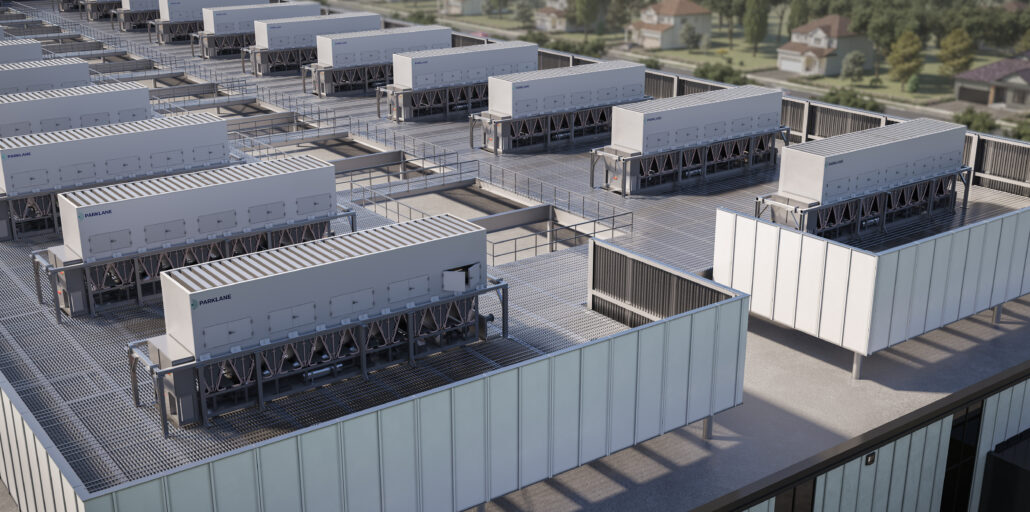
- Equipment is increasingly outdoors: chillers, condensers, generators, DX systems.
- AI clusters require massive cooling, exponentially increasing mechanical tonnage.
- Municipalities are tightening bylaws and enforceable thresholds.
- ESG frameworks now treat noise as an environmental impact metric.
Every year, more and more jurisdictions have been requiring:
- Acoustic reports
- Modeled scenarios
- Mitigation plans
- Acceptance testing
- Performance guarantees
According to Scott, “Urban data centers are going to need to be quiet by design. There’s no way around it.”

Looking Ahead: What The Data Center Of 2035 Will Look Like
Scott’s career background, including work with DARPA, gives him a unique perspective on the next decade. Here are his biggest predictions:
1. Quiet-By-Design Will Become Standard: Noise attenuation will be integrated at the specification level, not treated as an after-thought later.
2. AI Data Centers Will Dominate New Builds: AI clusters require an unprecedented amount of cooling and electrical capacity, driving:
- Larger mechanical yards
- More outdoor equipment
- Higher sound power levels
3. ESG Will Expand: Noise Becomes the Third Pillar: Alongside power and water, noise will become a core ESG metric.
4. Nuclear Micro-Reactors will Power Future Campuses: Behind-the-meter micro-reactors and other novel solutions will become part of the energy mix.
5. Permitting Will Become More Complex: Communities will push for:
- Tighter thresholds
- Transparency in design
- Proactive engagement
- Enforceable compliance mechanisms
6. Mechanical Efficiency Will Transform: Expect:
- Optimization of chiller plant design to promote airflow
- Quieter, high-tonnage cooling equipment
- Smarter systems to modulate load and noise output
7. “Loud” Data Centers Will Not Be Approved: Urban and suburban builds will require:
- Predictive acoustic modeling
- Guaranteed compliance solutions
- Community engagement early in the planning process

A Sector Defined By Change & An Opportunity To Lead
Few industries have transformed as quickly or as dramatically as the data center sector. The shift from bespoke enterprise builds to hyperscale, AI-driven, community-adjacent campuses has reshaped risk, design strategy, and community expectations. One thing is clear:
Noise is no longer a back-burner line item. It is a board-level concern and a defining risk for the next-generation of data center development.
As Scott notes, “We’re going to need unprecedented efficiency and innovation in how we build and operate data centers, and noise will be part of that conversation for the first time ever.”
For Parklane, this moment represents both a responsibility and an opportunity: to help the industry grow sustainably, responsibly, and in harmony with the communities it serves.
To explore Data Center solutions: https://parklanemechanical.com/data-centers
To learn more about Parklane’s process: https://parklanemechanical.com/our-process
To contact us for more information: https://parklanemechanical.com/contact